
lssdoc turns a LimeSurvey .lss export
into a polished Word (.docx) or PDF questionnaire document,
displaying up to four languages side by side, and runs a rule-based
audit of the survey. Everything stays on your machine.
The public API is four functions:
| Function | Role |
|---|---|
read_lss(file) |
Parse a .lss into a structured lss
object. |
audit_lss(input) |
Inspect a survey for anomalies. |
render_questionnaire(input, output, ...) |
Render the full questionnaire to Word or PDF. |
render_audit(input, output, ...) |
Render the audit findings alone. |
This vignette uses the demo survey that ships with the package – a synthetic four-language questionnaire (English, French, German, Spanish) with quotas and a consent block.
demo <- system.file("extdata", "demo_survey.lss", package = "lssdoc")Parse
read_lss() reads the .lss (XML) export into
a structured object, preserving every user-entered string verbatim.
lss <- read_lss(demo)
lss$languages
#> [1] "en" "de" "es" "fr"
Audit
audit_lss() flags reviewable anomalies – missing
translations, duplicate codes, forward filter references, array-scale
inconsistencies, orphan references – as a classed object with a
print() method. The demo survey is clean; a deliberately
broken fixture is included to show the output:
broken <- system.file("extdata", "audit_demo.lss", package = "lssdoc")
audit_lss(read_lss(broken))
#>
#> ── lssdoc audit ────────────────────────────────────────────────────────────────
#> File: /tmp/RtmpOxs2Du/temp_libpath1ac41ed28715/lssdoc/extdata/audit_demo.lss
#> Languages: "en" and "fr"
#> 12 findings: 5 errors, 7 warnings, 0 notes.
#> ✖ Survey: Duplicate question code: 'age'.
#> ✖ Question 'blank_q': The question text is empty in every language.
#> ✖ Question 'age': Filter references variable 'income' (item 4), which is not
#>   asked before this question (item 1).
#> ✖ Answer 'X': Answer points to question id '99999', which does not exist.
#> ✖ Subquestion 'orphan_sq': Subquestion points to question id '99999', which
#>   does not exist.
#> Question 'arr': Subquestions reference scale_id '0' but no answer options are
#> defined for it.
#> Question 'arr': Answer options reference scale_id '1' but no subquestions are
#> defined for it.
#> Question 'comment ': The question code 'comment ' contains whitespace;
#> LimeSurvey will export it verbatim, which usually breaks downstream lookups.
#> Group: The group name is empty in every language.
#> Question 'satisf': Type 'Single choice' expects answer options, but none are
#> defined.
#> Question 'rating': Type 'Multiple choice' expects subquestions, but none are
#> defined.
#> Question 'income' [fr]: The question text is missing in 'fr' but present in
#> other languages.
Render
render_questionnaire() writes the document; the output
format is inferred from the file extension (.docx or
.pdf). Rendering uses the suggested packages and .
# Parse once (above), then render different variants without re-reading.
render_questionnaire(lss, "review.docx")
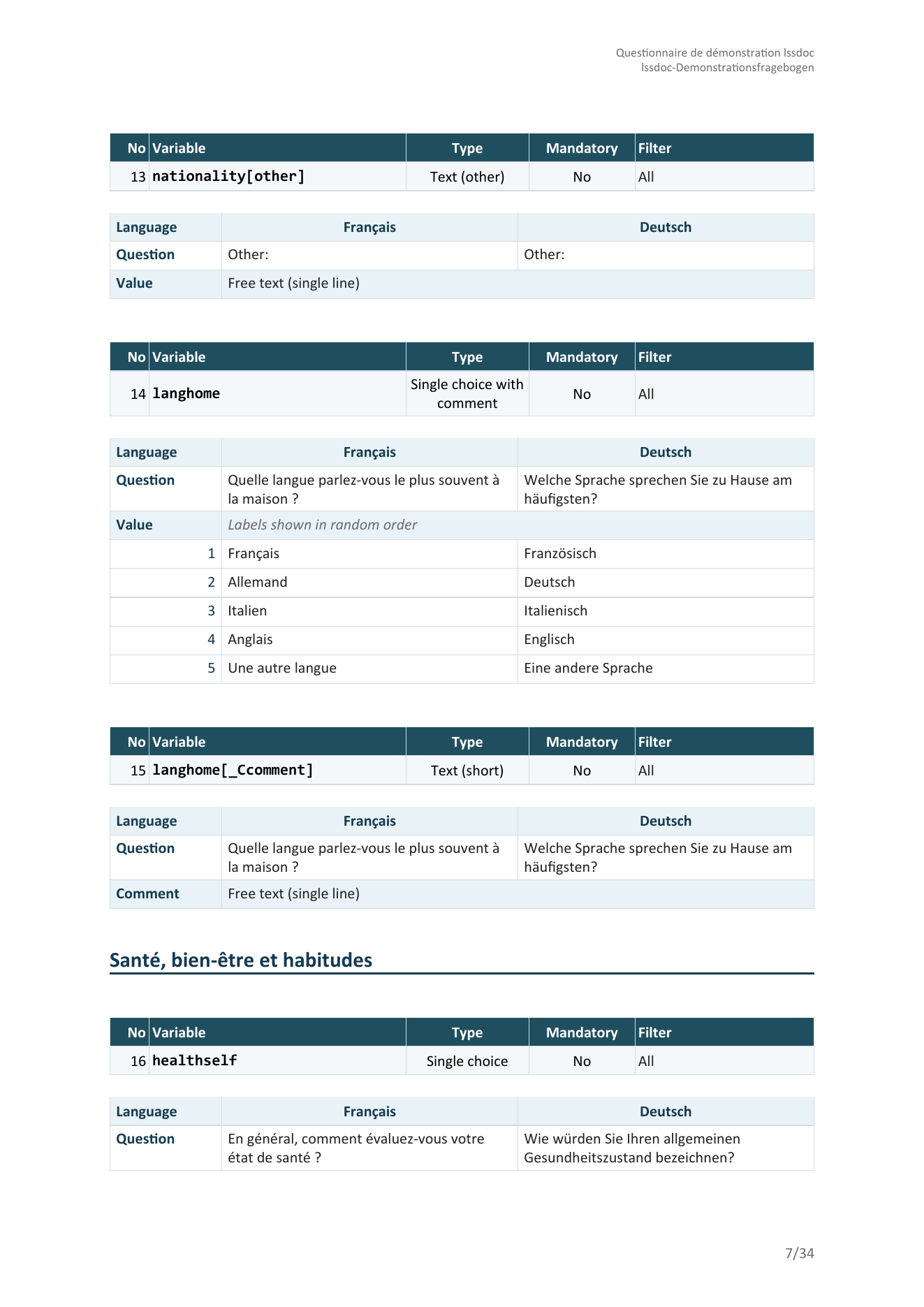
Two templates are available. The
"cards" template (default) stacks one
block per item – closest to the printed questionnaire:
The "table" template is one dense table
covering the whole document – one row per variable, with its value codes
beneath:
render_questionnaire(lss, "questionnaire.docx", template = "table")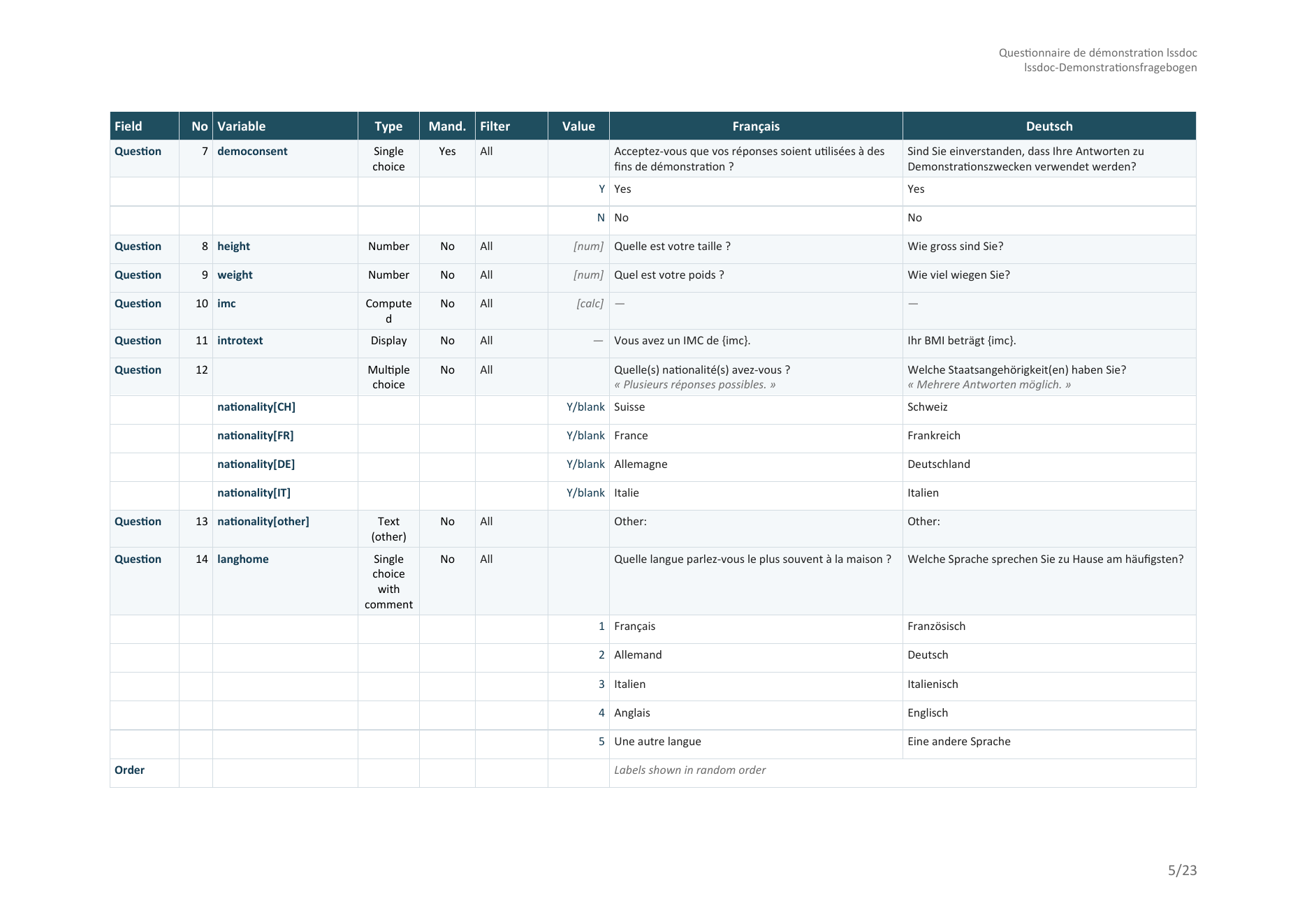
Useful arguments
-
languages– which content columns appear, and in which order (c("en", "fr")); the first is the primary language. -
chrome_lang– language of the document chrome (column headers, row labels, type labels), independent of the content languages. -
template–"cards"(default) or"table". -
variable_names–"brackets"(default) reproduces the LimeSurvey CSV/Excel export column names, so the variable index matches the raw data file;"underscore"uses the SPSS/Stata code form. -
base_size– body type size in points (default10); raise it (e.g.12) for a roomier single-language render. -
page_format–"auto","A4-portrait","A4-landscape"or"A3".
render_questionnaire(
  lss, "review_en_fr.docx",
  languages   = c("en", "fr"),
  template    = "table",
  chrome_lang = "en"
)
PDF output
Pass a .pdf path: the package writes a
.docx to a temporary location and converts it locally via
LibreOffice (which must be installed and on the PATH). No
upload, no network call.
render_questionnaire(lss, "review.pdf")Audit-only document
render_audit() produces a focused QA document – the
cover page, then one section per severity – separate from the full
review.
render_audit(lss, "qa.docx")